Chelsea hackett
Creating Performing and Participating in Theatre
Creating, performing and participating in theatre
One of the most appealing aspects of the NYU Educational Theatre program for me was the focus on creating theatre in many different forms. After graduating from my Master’s program, I felt that I had acquired a broad set of skills for how to facilitate the creativity of others, but I was itching to return to my own creative outlets. I also found that in my work in Guatemala and in NYC as a teaching artist, I was constantly trying to find new ways to focus on the affect of the work as it strengthens the effect. I borrow the use of these terms in reference to applied theatre from James Thompson, whose Performance Affects has served as a guiding text for my choice of coursework as well as my practice. Thompson suggests that “beauty, the call of the face, and a broad attention to the shock to thought produced by an affective register can be part of the explicitly political and aesthetic project” (Thompson, 2011, p. 178). My goal at NYU has been to develop my own aesthetic capabilities in order to utilize the “call of the face” in my work. Belenky et al speak to the need to integrate affect and effect as well when they talk about those will conceptual knowledge, "weaving together the strands of rational and emotive thought" (1997, p.134). My affective threads are outlined below.
One of the first courses that I took at NYU was Stephen DiMenna’s Advanced Playwriting course. I consider academic writing to be one of my skills, but I have often shied from creative writing. The only full-length play I had written before his class was my one-woman play, and I had never seen my work performed by a cast (besides myself). Encouraged by DiMenna and the writing process, I decided to rewrite and submit my 10-minute play, The Sorry Play, to the student-run play festival in the Educational Theatre department called Theatrix.
The Sorry Play was selected and performed both within Theatrix and also as a part of the Educational Theatre Forum on Site-Specific Theatre in the spring of 2015. I have included several archival pieces from this play including a recording of the Theatrix performance, the agenda for the Forum and the final script. From watching the performance of The Sorry Play and receiving feedback in DiMenna’s course, I found that creative writing is a skill I possess, but one that I will need to nurture. In order to do so, I have set a creative goal for myself to expand The Sorry Play into a vignette style play, similar to the form of David Ives’s Lives of the Saints.
Masks have intrigued me since my first time wearing a theatrical mask during a workshop with Joan Schirle of Dell’Arte International in 2009. That encounter lasted less than a few hours, but I knew that it was a form that I needed to explore more deeply. I have taken advantage of the many mask-making opportunities provided both at the Washington Square Park campus, as well as in the Educational Theatre program’s study abroad course in Puerto Rico. I also independently sought to infuse mask work into my work with Starfish, attempting to focus on affect, and a form that aesthetically interested me. I have included several different artifacts in order to show the progress I have made in my mask work during my time at NYU.
Masks in Guatemala
During my trip to Guatemala in the summer of 2015, Dr. Osnes and I were asked to create a workshop exploring the concept of “code-switching.” Starfish used this term to describe the skill of knowing how emotions and behaviors differ between professional and private settings. I felt that the best way to explore this issue would be through the abstraction of masks. I have included a short teaser video from this workshop, which features me revealing the masks and inviting several participants to try on the masks. This video only shows a small moment of a larger workshop, but it highlights the visual and “affectual” aspect of the workshop. While I felt confident leading a mask workshop, I didn’t yet have the skills to create masks. Because of this, I was excited and encouraged to take Professor Ralph Lee’s mask class in the fall of 2015.
Masks with Ralph Lee
In Professor Lee’s class, I was challenged to create several masks out of clay and papier-mâché. We started this process from scratch by creating plaster molds of our faces. We then used these molds as bases on which we shaped the form of the masks out of clay. After obtaining the desired form, we covered the mask in four layers of papier-mâché, and then painted them for our desired effects. Throughout the course of the class, I made two full-face masks, three half masks, one giant mask and a hand puppet. I have included images of these items at different stages of their creation.
While taking this class, I was also taking Dr. Smithner’s physical theatre course. I knew that the combination of physical theatre and mask work would result in (and has historically led to) powerful theatre, but I wanted guidance on how to marry the two. In order to learn more, I chose to take the program’s course abroad in Puerto Rico and study under mask maker and performer Deborah Hunt.
Mask Work in Puerto Rico
Theatre Practices in Puerto Rico is a course offered annually in January through the Educational Theatre department. It takes students to Puerto Rico to work in either mask-making and performance or physical theatre and performance. I took this course in January of 2016 and chose to study masks (and puppetry) with Deborah Hunt. Deborah Hunt is an internationally acclaimed mask maker, whose personal style is, put simply, to skirt norms. While her work will rarely be found in “usual” theatre spaces, it is none-the-less some of the most evocative and affect driven pieces I have had the pleasure to see.
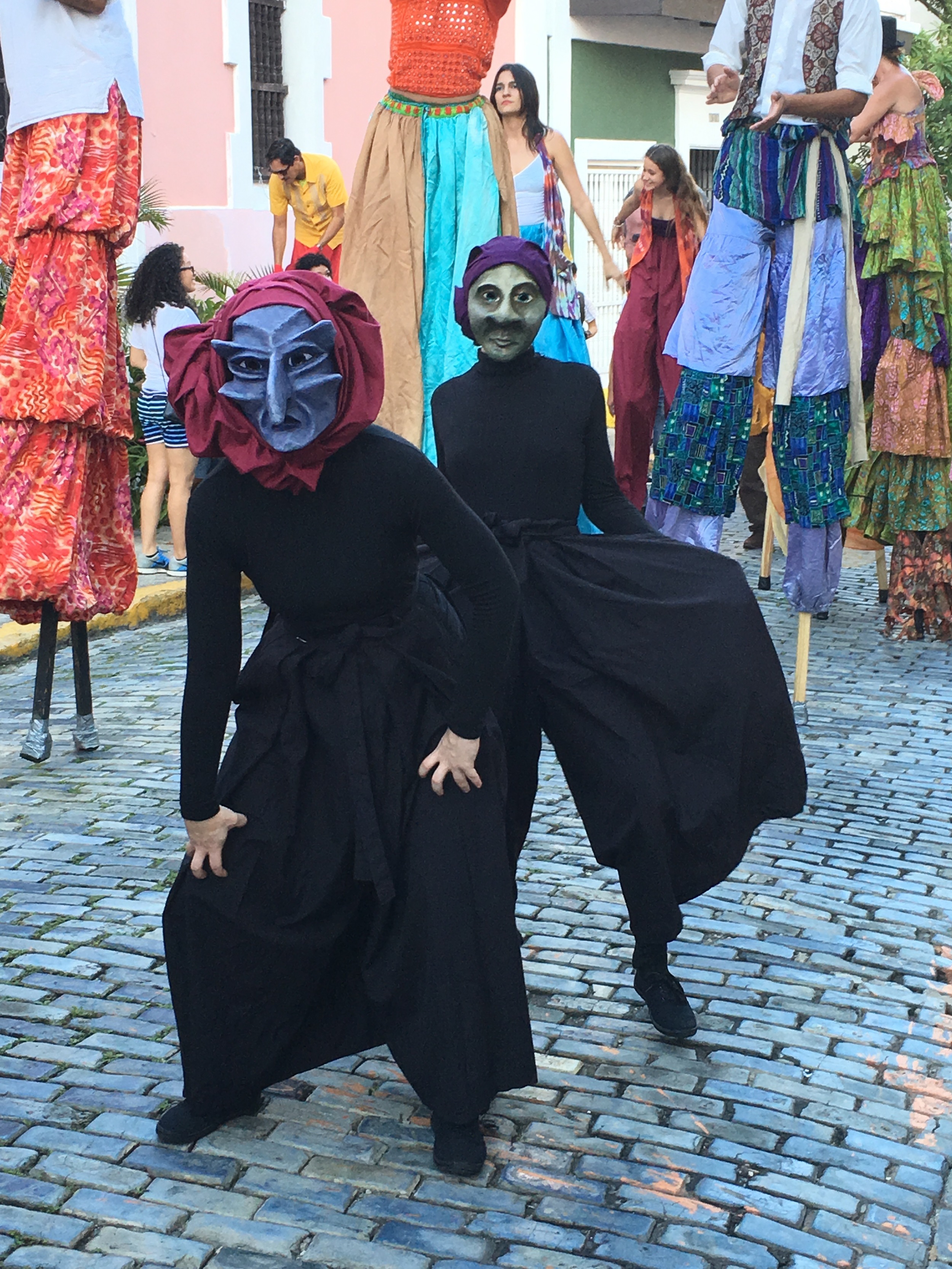
Over the course of two weeks, Deborah rigorously guided myself and five other students through the process of building a mask, a puppet, and an original performance that incorporated both objects. We performed this piece in a heavily populated public square during the San Sebastian festival and in a private performance for our peers. Additionally, we traveled in a masked procession as a part of one of the regular parades that make up the festival. I have included images of both the process of creating the mask and puppet as well as images of the procession and performances in order to highlight this experience.
This process pushed me to combine what I had learned in Lee and Smithner’s classes and solidified my adoration of mask and puppetry as powerful forms of theatre. Ajchowen, who will be a focus of my doctoral research, also use masks in their performance, so I found this process to serve a dual purpose of personal artistic growth as well as a form of embodied research. To further these pursuits, I have applied to the Bread and Puppet Theatre apprenticeship this summer; pending acceptance.