One woman's way of knowing
PDF version available here
This paper will serve as an exploration of the successes and failures that have led me to and through the PhD program in Educational Theatre. It is an attempt at using a reflective practice to link my personal experiences to my broader academic pursuits. As a woman, I am inquisitive about how my gendered reality influences the way I live, relate, and learn. This inquiry has connected me with many feminist theorists ( Frey, 2013; Gilligan, Spencer, Weinberg, & Bertsch, 2003; hooks, 2000; Lorde, 2007) whose work has informed my research. Building on this, I have chosen to explore my academic journey through the frame of Belenky, Clinchy, Goldberger and Tarule’s Women’s Way of Knowing (1997). In their foundational text, they describe gendered female knowledge going through five stages: Silence, Received Knowledge, Subjective Knowledge, Procedural Knowledge, and Constructed Knowledge (see Figure 1).
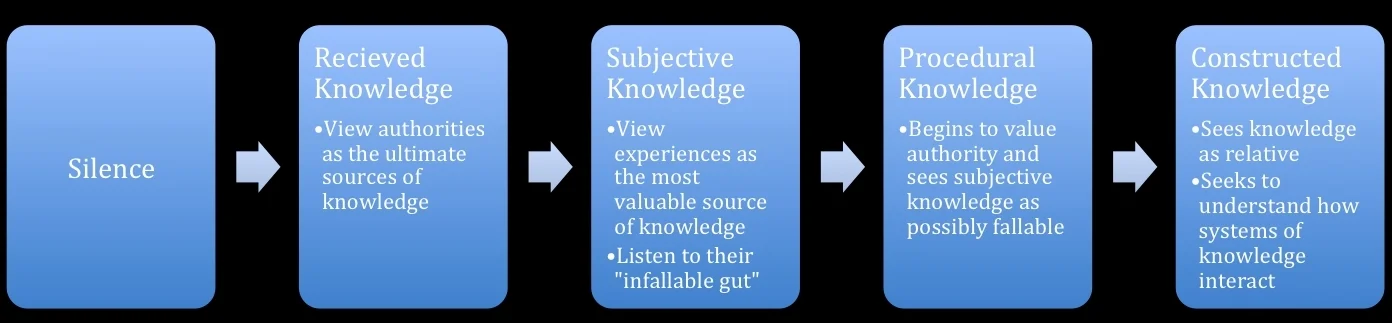
Figure 1. Shows an outline of the stages of knowledge as conceptualized in Women’s Ways of Knowing (Belenky, Clinchy, Goldberger, & Tarule, 1997).
While my academic growth has not been an entirely linear process as the stages might suggest, I see their frame as a valuable way of explaining points of growth in my own career and conceptualizing where I am today as a practitioner and student. For the first section of this paper, I have outlined my process of arriving at the PhD program as my journey has informed the choices I have made within the program. The final section of this paper details the artifacts I have chosen for my portfolio which demonstrate the work I have completed during my time as a PhD student.
Received Knowledge
I have a history of being good at school. I listened to instructions (good!) I regurgitated what I was taught (good!) I obeyed the rules (very good!). From a young age, I learned how to write essays in a five paragraph style and receive above average grades in my classes. My skills allowed me to skip the 7th grade and graduate high school at age 16 with an International Baccalaureate Diploma.[1] However, despite my ability to achieve academically, I still found myself deferring to the authority of my teachers for developing my own knowledge. I was in a stage in my life where I was very good at being a “received knower.” Belenky et al describe received learners as those who “(believe) that truth comes from others, they still their own voices to hear the voices of others” (1997, p 37). From the beginning of my education to partway through my undergraduate experience, I was more attuned to the voices of others than my own voice within.
In 2008, I was midway through two undergraduate degrees at the University of Colorado at Boulder(CU-Boulder): A BFA in Acting and a BS in Media Studies. At that time, my classes were sites of replication. My BFA courses encouraged me to reproduce the scenes of great playwrights and to follow the teachings of acting theorists. I learned how an actor prepares from Stanislavski. I followed the advise of acting pedagogues such as Michael Chekhov, Uta Hagen, and Sanford Meisner. Despite my obedience to their teachings, my understanding of theatre, much like the way I memorized my lines, was rote. The same pattern emerged in my Media Studies coursework. On a cursory level, I understood the critiques offered by media theorists Roland Barthes, Susan Sontag, and Erving Goffman. I was able to apply their critical lenses to a variety of media artifacts, but I was in a monological relationship with their writing. Belenky et al describe received knowers as having “no way to determine ‘truth’ without the aid of an authority” (1997, p. 40). I was stuck in a place where I absorbed the knowledge of those I perceived as authority without engaging in a dialogue with their work.
While my struggle to author my own knowledge plagued me in both of my degree programs, the two worlds remained disparate in my mind. The closer I got to graduation, the more I feared I would have to make a choice between two (seemingly) disparate career paths. I loved performing and valued the experiences and skills I gained within my BFA program. I was able to perform in plays ranging from the restoration comedy The Country Wife, to Yasmina Reza’s Life x 3. By all measures I was gaining the skills to become a working actor. However, I also thrived on the academic rigor and critical engagement offered in my Media Studies courses. I enjoyed spending hours on end writing research papers on topics such as “The Role of Grassroots Radio Under the Chilean Dictatorship.” I was torn between the draw of both fields; one asking me to immerse myself in the production of theatre, and the other asking me to step into the world of theoretical analysis and away from my own cultural production. I hadn’t been introduced to a way in which the two could overlap, and didn’t yet trust my ability to merge them.
It was this pressure to choose that triggered my change from being a receiving knower to a subjective knower. This move, as Belenky et al describe it, was a shift from “from passivity to action…from silence to protesting inner voice and infallible gut” (Belenky et al., 1997, p.54). My protesting inner voice told me that I was not meant to live fully in either field. The voice screamed out that I was not built for the world of auditions, monologues, headshots and reels and had no interest in leading the life of a working actor. It also objected to the idea of living in a theoretical and fully academic world of media studies, critiquing advertisements and articles while not creating my own. It was at this critical point in my academic career when, in a moment of kismet, I was given an experience that exposed me to a field that seemed to marry both of my interests.
Me, the Subjectivist
At the height of my internal struggle for escape, I met Dr. Beth Osnes, a professor of theatre at CU Boulder, who gave me the chance to experience a new type of theatre. Osnes put out a request for Spanish-speaking students to join her on a sponsored trip to Guatemala to participate in “Theatre for Social Change.”[2] At the time, I didn’t know what theatre for social change was, but I heard my protesting inner voice at full decible saying that I needed to find out. I matched her call, as I spoke conversationally fluent Spanish from a semester studying abroad in Santiago, Chile. I introduced myself to Dr. Osnes, and asked if I could join. She agreed. In 2009, I traveled with Dr. Osnes and a group of funders, fellow students, and her entire immediate family for a month around the Western Highlands of Guatemala. We worked with several organizations serving Guatemalan mothers and youth. We assisted Osnes with her facilitation of a Vocal Empowerment (VE) workshop with young Mayan girls at scholarship granting organization called Starfish One by One.
Starfish One by One (Starfish) is an organization that, in 2009,[3] granted scholarships for young Mayan women to attend secondary school. In addition to funding, Starfish also provided mentorship programs for the girls to support their academic success. We were asked to create a workshop to be conducted in a mentorship group of girls ages 12-18, with the goal of helping the girls “make (their) voices strong, so that (they could) achieve (their) dreams” (Osnes 83). In the VE workshop, we guided the girls through a series of vocal exercises developed by Kristin Linklater (2006). We also led them through several games, including “Circle of Names” and a variation on “The Blind Series” from Augusto Boal’s Games for Non-Actors (2002, pp. 107, 115). We then asked them to share their most audacious dreams for their lives. After sharing, we led them through an “Obstacle Course of Dreams” in which they acted out overcoming possible challenges that they might encounter when achieving their dreams.[4] These improvisations had elements of Michael Rohd’s “activating scenes” in that they “(did) not show what to do… they (asked) what could be done (1998, p. 97). At the end of the workshops, we had the girls exchange colorful beads while offering affirmations to their classmates. At the end of the workshops, one participant responded, “It was good to learn how to use our voices because we do not think of our voices as strong” (Osnes, p. 95).
My lived, subjective knowledge from Guatemala allowed me to see that the skills I had gained as a performer and critical theorist could be merged in the pursuit of a singular new aim: Theatre for Social Change. Upon returning to the US, I was inspired to continue working with theatre that served a greater purpose. This meant undertaking two more projects where I would learn by experience. I chose to pursue an Honor’s Thesis, an optional track at CU Boulder. For this, I wrote and performed a one-women show entitled Skin Deep, which explored the idea of “Body Image” through the lens of eight different characters.[5] While I had taken a class on solo performance, I created most of the 45-minute play through trial and error. I was inspired by Eve Ensler’s The Vagina Monologues (2001) and Jane Wagner’s The Search for Signs of Intelligent Life in the Universe(Wagner, French, & Tomlin, 2012). Most of the dialogue came from experiences struggling with my own body image. After performing the show and writing about the process, I received the Summa Cum Laude designation for my work.
In addition to exploring a social issue through performance, I also wanted to continue using theatrical techniques as a tool for social change, as I had done with Osnes in Guatemala. In order to do so, I founded a student group on the CU-Boulder campus called Performers Without Borders.[6] I served as the President during my senior year and organized several on-campus events. We hosted an “Arts For Activism” weekend in which students performed socially focused original theatre pieces (including an excerpt from Skin Deep.) We held a retreat where a consultant taught us Theatre of the Oppressed exercises (Boal, 2002). We gave away roses for World Peace Day. On top of the projects that we were able to undertake locally, many of the students wanted to experience what led me to create the group in the first place. In response, I put plans in motion to go back to Guatemala.
At 21 years of age, I undertook the largest project of my life at the time. I organized, secured funding for, and led a 2-week return trip to Guatemala with five other students. While in country, I oversaw our travel as well as organized and executed fourteen workshops with five partner organizations. Our partner organizations included sites I had visited the year before and connections I made in Colorado while planning for the trip. Most of the workshops that we led consisted of simple drama activities or adaptations of the VE workshop. However, when we returned to work with Starfish, they requested that we create two new workshops: one for the mentors and one for a mentorship group of girls.
Our workshop for the mentors was my first experience with professional development, a field I have since been exposed to often. In this workshop, we taught the mentors various theatre games. Working with adults intrigued me, as it offered new challenges. In our second workshop with Starfish, we repeated some of the same techniques that I had used the year before and added a few extra games. I led a game in which each girl was invited into a circle one by one to yell their names as loud as they could (while still protecting their vocal chords). Some of the girls we were working with had a very hard time achieving this task, or even entering the circle. As a young facilitator (and trained only through limited experiences)[7] I encouraged all of them to try, even when they resisted. One student, Maria, resisted to the point where she could barely take a step into the circle, let alone yell aloud. In the spirit of inclusion, I continued to encourage her to try it. Eventually she was able to step in, throw her arms above her head and say in a quiet yell “Maria!” I left the workshop feeling that we had done well.
We almost left Guatemala without a hitch, but the trip ended in chaos. The Villarica Volcano erupted, spewing ash over Guatemala City. At the same time, Tropical Storm Agatha hit down on the region, turning the ash into a concrete-like mixture that shut down the Guatemala City airport for two weeks. We needed to return to the US, so I, the “fearless” 21 year old leader arranged for us to drive to El Salvador and fly out of the San Salvador airport. I was unaware that this would mean driving through the flooded roads Agatha had left in her wake. This confluence of natural disasters was traumatic for the group, but for me it felt like an outward manifestation of a crisis that had been brewing inside of me since my first trip to Guatemala. I left Guatemala exhausted physically, emotionally, and spiritually. As a young group leader, I had taken on all of the in-country responsibilities, including the majority of the facilitation. My eagerness to gain experiences and learn subjectively left me exhausted. I was unaware of how to delegate or where and when to ask for help. Beyond my growing feeling of being overstretched, I was beginning to question what right I had to be in Guatemala facilitating in the first place.
While I didn’t have the word for it at the time, the way in which we were conducting our trip felt neo-colonial. Some of the groups we worked with seemed to view us as a “panacea” and wanted us to solve problems that were beyond our capacity to address. In reality, we could only offer them the theatre we knew. I understood that our Whiteness and American citizenship both projected and gave us a type of power and mobility in the spaces we entered, but I had difficulty processing my responses to this power and I felt guilt and confusion. I also felt that our approach of “doing as much as possible in two weeks” led to us feeling like philanthropic tourists. We came, we barely learned the names of those that we were working with, we conducted the workshops, and we left. I was at another turning point in my learning process. When I returned to the US, I met with one of my mentors and tried to put my crisis into words through a series of questions:
Why was I as a white woman doing this work?
How is this work any different from missionaries?
Did I really see the people I was working with as people, or as a sort of tourist attraction?
What are the ethics behind the work I was doing?
What are the best practices of the work?
Even though I enjoyed the work, was I really doing “good”?
For the first time, I was turning the critical lens I had developed in my Media Studies program on my own work, and it felt deeply uncomfortable. I tried to ease my mind be telling myself “it’s theatre, we didn’t do any damage.” However, my infallible gut was telling me that we had taken a risk and practiced too much hubris by leading these workshops without thinking through the ethics of the work beforehand. Years later, Dr. Osnes heard a story from the director of Starfish, Norma, that confirmed that my discomfort was justified.
Dr. Osnes wrote about this story in her last book, Theatre for Women’s Participation in Sustainable Development. There, she describes the incident of me coaxing Maria to participate, through Norma’s perspective:
Norma said that one girl, Maria, had a particularly difficult time with this and that Chelsea continued to encourage her to try. Norma, knowing Maria’s extremely unstable home life and the trauma she had faced, felt uncomfortable with the situation and considered rescuing Maria from the activity. In the end, Maria found the courage to yell before Norma acted upon her urges. Norma said that now this girl is doing extremely well. She wonders what turned the switch for Maria and wonders if it could have been that moment… Norma said that she doesn’t feel as though she has the experience to know how far to keep pushing or when to rescue the girls in regard to applied theatre activities (Osnes, 2014, p. 98).
When I heard that story, almost five years after it had occurred, I felt a churn of fear in my stomach. I was lucky that whatever “switch” Norma perceived as having turned in Maria went in a direction of positive change. Hearing this solidified the gut instinct I had when I returned to the US in 2010. It validated the shift that I felt from wanting only subjective knowledge to needing a stronger procedural understanding of our field, so that I could create workshops where no one needed to be rescued.
Belenky et al describe the shift from subjective knowledge acquisition to procedural knowledge acquisition as a newfound understanding that “intuitions may deceive; that gut reactions can be irresponsible and no one’s gut feeling is infallible; …that truth can be shared, and that expertise can be respected” (Belenky et al., 1997)to find experts with whom I could engage in “conscious, deliberate and systemic analysis” (p. 93) of the field of theatre for social change. I carried this desire with me when I moved to New York City after graduation.
Searching for Procedural Knowledge
I arrived in New York City in September of 2010 after spending the summer after Guatemala interning as an actress with the Colorado Shakespeare Festival. I began auditioning for straight theatre roles, but it only took a few auditions for me to confirm what I knew as an undergraduate: the life of a working actor was not for me. I was wary to dive headfirst into theatre for social change again, but I knew that I would be happiest if I was working in that field. I was encouraged to look for Teaching Artist (TA) jobs by a former professor. I was hired for my first TA position with “Story Pirates”.
Story Pirates is a bi-coastal arts-in-education company that guides students in kindergarten through fifth grade in writing stories and then performs selected stories as a sketch comedy (Story Pirates Inc., n.d.). While I started as a TA, over the course of the past 5 years that I have worked with Story Pirates, I have held a wide range of responsibilities within the company. After working for a year within the education branch, I joined the Acting Company, which consists of professional actors, largely those trained in improvisational comedy. I went on to become a director, leading groups of 5 actors in devising new sketch shows based on children’s stories. I also served an administrative role for two years, both hiring and training new TAs.
As I began my work with Story Pirates, I started to gain confidence in my ability to facilitate, however I was still left ruminating on the questions that arose after Guatemala. Through a colleague at Story Pirates, I discovered an opportunity to acquired the procedural knowledge I dired: the Masters in Applied Theatre (MAAT) at the City University of New York- School of Professional Studies (CUNY-SPS). I wasn’t aware at the time that there was a similar program at New York University. I remember leaving my audition for MAAT and feeling as though a weight had been lifted off of my shoulders. I had found a place in which I could deeply seek answers with a cohort of like-minded individuals.
My time in the MAAT program shaped my relationship with Applied Theatre (the new term I learned to describe Theatre for Social Change). I was introduced to the writing of theorists who had worked to define the field. Helen Nicholson told me that applied theatre could be understood as “theatrical and cultural practices that are motivated by the desire to make a difference in the lives of others” (2005, p. 17). James Thompson explained, “applied theatre projects always take place in communities, in institutions or with specific groups. They often include the practice of theatre where it is least expected” (2003, p.15). Anthony Jackson expounded on “forms of theatre practice that aim to effect a transformation in people’s live, whether that be the activation of a process of attitudinal or behavioural [sic] change on the part of the audience or the creation or consolidation of consciousness about the audience’s place in the world” (2007, pp. 1-2). I began to articulate my own working definition of applied theatre, a term that seems to struggle between expanding and constraining. I started to see applied theatre as theatre outside of the theatre space, used with the intention to change.
Belenky et al describe procedural knowers as operating in two ways: connected and separate. They describe them both: “Separate knowers learn through explicit formal instruction how to adopt a different lens—how, for example to think like a sociologist. Connected knowers learn through empathy. Both learn to get out from behind their own eyes and use a different lens, in one case the lens of a discipline, in the other the lens of another person” (1997, p. 115). The MAAT exposed me to both types of knowing. As a separate knower, I began to understand the theories and mechanisms through which applied theatre operates. As a connected knower, I learned way in which I could empathize with and understand the communities I was working in, in order to create workshops with the participants in mind.
Separate Knowledge
From the writings of Ivan Povlov, Jean Piaget, John Dewey, and Michelle Fine, I began to see where applied theatre was tied to the broader worlds of child development and education. Their writings allowed me to see my theatre work through the eyes of teachers, sociologists, and developmental psychologists. In my courses, I was challenged to explore many different facets of applied theatre in a practical way.
In my courses with renowned theatre director Helen White, I learned how to devise theatre. Devising, or playbuilding as it is also know, is “the creative process of assembling a dramatic performance or presentation from the building blocks of drama and theatre, through improvisation, discussion and rehearsal” (Bray, 1994, p. 2). I directed my fellow graduate students in a show inspired by a children’s book and led members of the Creative Arts Team Youth Ensemble (CAT Youth) program in devising a piece of theatre. I worked with CAT Youth further as an apprentice to Helen White during her annual playbuilding program.[8] Both the creative and administrative opportunities from that apprenticeship have informed me in contributing to the NYU Educational Theatre community, as I have served as the Company Manager of the Youth Theatre Ensemble (YTE)[9] for Spring 2015.
In my courses with MAAT Academic Director, Christopher Vine, I created several different types of applied theatre. I collaboratively created a piece of Forum Theatre, and learned how to work as both a forum actor and a Joker; all from the teachings of Augusto Boal (1979). This experienced served me in my work as a TA. In addition to Story Pirates, I began working with New York City Children’s Theatre (formerly Making Books Sing) and toured a forum-inspired workshop called Alice’s Story[10] for first and second grade students that addressed the topic of “bullying.”
In other courses with Vine, I collaborated on creating a process drama, described by Pamela Bowell and Brian Heap as a genre of theatre in which “the participants, together with the teacher, constitute the theatrical ensemble and engage in drama to make meaning for themselves ( 2001, p. 7). We drew from Dorothy Heathcote’s writings on the “mantle of the expert”(Heathcote & Bolton, 1995), Cecily O’Neill’s theories on creating process dramas (1995), and Gavin Bolton’s conceptual classifications of drama in education(1979), to create a process drama that explored the complexities of allowing “fracking”[11] in a community, which we again presented to the CAT Youth Ensemble members. Jonothan Needlands and Tony Goode’s Structuring Drama Work (2000) proved to be a useful text for building both our process drama and a Theatre in Education piece that I co-created and toured to a local high school.
The courses, coupled with my continued outside work as a TA, allowed me to gain substantial amounts of separate knowledge. However, the most valuable takeaway from my time at the MAAT program was my immersion in the teachings of Paulo Freire, which allowed me to become a connected knower.
Connected Knowledge
Belenky et al describe connected knowers as those who “begin with an attitude of trust; they assume the other person has something good to say… Their purpose is not to judge, but to understand” (1997, p.116). Paulo Freire’s Pedagogy of the Oppressed(1993) offered a pathway to developing connected knowledge alongside the participants of the workshops I was leading or the classrooms I was instructing. Freire conceives of a teacher as “no longer merely the-one-who-teaches, but one who is himself taught in dialogue with the students, who in turn while being taught also teaches” (1993, p. 61). Freire’s pedagogy espouses the same attitudes as connected knowers (or visa versa). Freire advocates for the necessity of dialogue for both knowledge acquisition and creation. This dialogue, or “naming of the world… is not possible if it is not infused with love” (1993, p. 70). I believe Freire’s “love” and Belenky et al’s “trust” are equal. Both support approaching others with non-judgment. Freire goes as far as to offer the questions: “How can I dialogue if I always project ignorance onto others and never perceive my own?... How can I dialogue if I am closed to—and even offended by—the contribution of others?” (1993, p. 71). As a teaching artist, I began to apply these questions to my work with New York City youth. I tried to listen to my students and learn from their humor, thoughtfulness and personal experiences, rather than solely seeking to impart my knowledge to them.
Many practitioners and theorists view Freire’s pedagogy as essential to applied theatre. The underlying tenants of his pedagogy are imbedded in the language used by theorists to describe effective practice. This can be seen in James Thompson’s offering that “theatre… (has) the potential to create active, critical citizens” only if it is “participatory, encourage(s) young people to be subjects of a learning process, and stimulate(s) self-reflection and a wider reflection on society” (1998, pp. 207-208). In that statement, Thompson adopts Freirean concepts of “action,” “critical reflection”(Freire, 1993, p. 109), and “subjectivity”( p. 51). Following the guidance of applied theatre theorist, I have found ways to adopt and integrate Freire’s pedagogy into my work.
Freire offers a method by which I can reflect on my practice before, during, and after it occurs. : Praxis. Freire describes praxis as “reflection and action upon the world in order to transform it” (1993, p. 33). By working to constantly reflect on my practice, I have hoped to curtail a repetition of the crisis I experienced after my second trip to Guatemala. Freirean practice also helps me to address the questions I had after returning from that trip. Now, I have a new set of guiding questions that I ask before I begin a new project developed from Freirean thought and dialogue with my fellow graduate students:
Was I invited?
What skills do I have to offer?
Is the program sustainable?
Where is there structure and where is there freedom within the process?
How can I defer to the participants?
These questions have guided my work as an applied theatre practitioner, theatre maker, and researcher.
Praxis in Practice
My time at the MAAT program culminated with a thesis, which provided an opportunity to put my procedural knowledge- both separate and connected- into practice. My thesis partners, Diana Garten and Heather Lanza and I conducted five workshops in a non-secure detention center for girls in Manhattan. We used theatrical techniques, coupled with writing exercises, to explore the topic of agency. I was particularly interested in the ways in which applied theatre practices resemble Relational Cultural Therapy (RCT). Built off of the work of Carol Gilligan’s In a different voice: A psychological theory and women’s development (1993) as well as Jean Baker Miller’s Toward a new psychology of women(Miller, 1986), RCT places relationships at the center of women’s development. Stephanie Covington recommends the use of RCT for gender-responsive juvenile reform (1998). I hoped to illuminate the overlap between RCT and applied theatre practice in order to advocate for future reform efforts for girls. This experience offered many opportunities for praxis, as it was both academically and practically challenging. I have chosen a selection of my thesis as an artifact for my candidacy, as well as a memo I wrote for a class in the Wagner school in which I transformed our case study into a recommendation for policy. I have selected both to demonstrate my understanding of the cultural dimensions and contributions of theatre. More detailed information and a link to those artifacts can be found here.
Perhaps the second greatest kismet in my life and the best opportunity to put what I had learned in the MAAT program into practice was Starfish’s 2013 invitation for Dr. Osnes and I to expand upon the Vocal Empowerment work we had started four years before. This invitation signaled the beginning of what will become my doctoral work, and also the start of a new form of my knowledge creation: constructed knowledge. Belenky et al. (1997) describe constructivist women as those who “aspire to work that contributes to the empowerment and improvement in the quality of life of others” (152). The invitation to Guatemala was the embodiment of my aspiration to work towards that lofty goal.
A return to Guatemala
My return to Guatemala felt like a manifestation of praxis. I had taken three years to reflect on my first two trips, and this allowed me to put into practice the lessons I learned in the MAAT program. The set up answered the questions for “good work” that I had established through my Masters program and my encounters with Freirean pedagogy:
· Was I invited?
o Yes. Starfish had explicitly asked us to return after considering the needs of their organization. Additionally, Starfish operates under the tenants of Freirean education, so our values are well aligned.
· What skills do I have to offer?
o Starfish had asked for the development of the theatre-based Vocal Empowerment program, and we felt ready and able to fulfill that request.
· Is the program sustainable?
o I would be training the mentors again instead of working with the girls directly, allowing us to work as colleagues and create a more sustainable program. Additionally, as this would be my third time visiting the same organization, I was building a longer-term relationship.
· Where is there structure and where is there freedom within the process?
o The structure was provided by the constraints of the program, but we were creating freedom by allowing the content to come from Starfish.
· How can I defer to the participants?
o Starfish’s coordinators would guide the program’s development.
We came back to Guatemala with a toolbox of theatre techniques and guiding ethics, but we had to find the ways in which those tools and practices operated in the Guatemalan context. Belenky et al. (1997) describe constructed knowers or constructivists as those who “see that all knowledge is a construction and that truth is a matter of the context in which it is embedded” for them, “(t)heories become not truth but models of approximating experience” (p.198). Upon returning to Guatemala, I began to see that “truth” was contextualized in what we were doing. This meant asking better questions and designing programs that fit the context, which takes time. Our initial two-week trip in 2013 grew into an annual event.
Since 2013, Dr. Osnes and I have continued to deepen and expand the role that VE plays within Starfish. On each visit, we meet with the program coordinators to determine how the exercises we taught the last time have worked for the mentors. We then introduce our plan for the current trip, and take the coordinators suggestions for adjustment. We lead three 8-hour training sessions with the mentors, and then receive feedback from the mentors and the coordinators on the work that we have just presented, hoping to inform what we bring for the return. It is constantly a circle of improving, trying, reflecting, and returning. From this process, in 2015 we created a 12-session “Introduction to Vocal Empowerment” program that can be disseminated to other organizations working directly with girls. I have included a selection these sessions in my portfolio to demonstrate my ability to know and use theatre materials and resources. These selections can be found here. After three years of developing the program, we are ready to begin data collection on this work and will be conducting four case studies of the program in separate locations: Guatemala, Tanzania, New York City and Boulder, Colorado.
Starfish has gone through a reflective practice as an organization as well and has elected to change their way of working in their community. In 2017, they will be opening a school to serve the girls to whom they formerly gave scholarships. One of the educational pillars they have elected to adopt for the school is VE. This provides new challenges for Dr. Osnes and myself as we redefine what the program will look like in the classroom on a daily basis. In addition to incorporating VE, in 2016 Starfish contracted me to build their art curriculum for the school, which covers four areas of artistic competencies: Dance, Theatre, Visual Art, and Music. I have also included a segment of this curriculum under the heading of “knowing and using theatre materials and resources.” You can see this selection here.
As my work in Guatemala has broadened and deepened, I have found myself forming a community of colleagues. Community is a term that holds many different meanings however, the community which I see myself belonging to in Guatemala is similar to what Zygmunt Bauman calls for: “a community woven together from sharing and mutual care; a community of concern and responsibility for the equal right to be human and the equal ability to act on that right” (Bauman, 2004, pp. 149-150). With a continued focus on girls and women, my colleagues and I have formed connections based on our interest in equality. In 2014, this community expanded to include a theatre company called Ajchowen, a branch of a wider cultural center known as Sotz’il Jay, Ajchowen is an all-female theatre group that uses theatre to explore the current state of Mayan women in Guatemala. The members of Ajchowen have agreed to allow me focus my doctoral research on a partnership between them and Starfish, beginning sometime in 2017.
My expanding work in Guatemala has driven my need to understand more areas of study than applied theatre. This need is what led me to apply to the PhD program in Educational Theatre in 2013, and what has given me areas of focus for my coursework throughout the past 1.5 years. My partnership with Starfish is by far the most comprehensive example of my capabilities and struggles in the field of applied theatre has required me to mobilize all of my theatrical skill areas in some capacity. For this reason, my work there is also the most difficult to demonstrate in delineated sections. However, in an attempt to express this project’s wide-reaching impact on my practice, as well as my continued focus and dedication to the topic through my coursework and future doctoral research, I have included some aspect of this work in each segment of my portfolio.
The need for the PhD
I hoped to find, at Steinhardt, an opportunity to expand my constructed knowledge. Belenky et al. explain that, “unlike procedural knowers, who remain subservient to disciplines and systems, constructivists move beyond systems, putting systems to their own service. They make connections that help tie together pockets of knowledge” (1997, p.140). Further, Belenky et al. posit that “constructivists seek to stretch the outer boundaries of their consciousness… by imaging themselves inside the new poem or person or idea that they want to come to know and understand” (1997, p. 141). I have sought out courses and projects that allow me to place applied theatre “inside of new poem(s)”: the poems of policy-making, social work, performance theory, educational reform, and psychology.
The content of this candidacy portfolio is the result of my experiences at NYU over the past 1.5 years and my efforts to deepen my theatre competencies while putting that knowledge in conversation with other disciplines. While not all of the work has occurred within a class, all of it has been informed by my classroom learning. All of the work that I have included was completed within my three semesters at NYU, save for a selection of my Master’s thesis included to demonstrate my attempt to turn academic research into a policy recommendation. I hope that this paper serves to demonstrate my journey leading up to the PhD program, and the artifacts I have included in this digital portfolio will outline both the progress I have made in my constructivist knowledge acquisition at NYU so far, as well as the gaps that I hope to fill through my remaining coursework and independent research.
Portfolio Contents
Creating, performing and participating in theatre
One of the most appealing aspects of the NYU Educational Theatre program for me was the focus on creating theatre in many different forms. After graduating from my Master’s program, I felt that I had acquired a broad set of skills for how to facilitate the creativity of others, but I was itching to return to my own creative outlets. I also found that in my work in Guatemala and in NYC as a teaching artist, I was constantly trying to find new ways to focus on the affect of the work as it strengthens the effect. I borrow the use of these terms in reference to applied theatre from James Thompson, whose Performance Affects has served as a guiding text for my choice of coursework as well as my practice. Thompson suggests that “beauty, the call of the face, and a broad attention to the shock to thought produced by an affective register can be part of the explicitly political and aesthetic project” (Thompson, 2011, p. 178). My goal at NYU has been to develop my own aesthetic capabilities in order to utilize the “call of the face” in my work. Belenky et al speak to the need to integrate affect and effect as well when they talk about those will conceptual knowledge, "weaving together the strands of rational and emotive thought" (1997, p.134). My affective threads are outlined below.
One of the first courses that I took at NYU was Stephen DiMenna’s Advanced Playwriting course. I consider academic writing to be one of my skills, but I have often shied from creative writing. The only full-length play I had written before his class was my one-woman play, and I had never seen my work performed by a cast (besides myself). Encouraged by DiMenna and the writing process, I decided to rewrite and submit my 10-minute play, The Sorry Play, to the student-run play festival in the Educational Theatre department called Theatrix.
The Sorry Play was selected and performed both within Theatrix and also as a part of the Educational Theatre Forum on Site-Specific Theatre in the spring of 2015. I have included several archival pieces from this play including a recording of the Theatrix performance, the agenda for the Forum and the final script. From watching the performance of The Sorry Play and receiving feedback in DiMenna’s course, I found that creative writing is a skill I possess, but one that I will need to nurture. In order to do so, I have set a creative goal for myself to expand The Sorry Play into a vignette style play, similar to the form of David Ives’s Lives of the Saints.
Masks have intrigued me since my first time wearing a theatrical mask during a workshop with Joan Schirle of Dell’Arte International in 2009. That encounter lasted less than a few hours, but I knew that it was a form that I needed to explore more deeply. I have taken advantage of the many mask-making opportunities provided both at the Washington Square Park campus, as well as in the Educational Theatre program’s study abroad course in Puerto Rico. I also independently sought to infuse mask work into my work with Starfish, attempting to focus on affect, and a form that aesthetically interested me. I have included several different artifacts in order to show the progress I have made in my mask work during my time at NYU.
Masks in Guatemala
During my trip to Guatemala in the summer of 2015, Dr. Osnes and I were asked to create a workshop exploring the concept of “code-switching.” Starfish used this term to describe the skill of knowing how emotions and behaviors differ between professional and private settings. I felt that the best way to explore this issue would be through the abstraction of masks. I have included a short teaser video from this workshop, which features me revealing the masks and inviting several participants to try on the masks. This video only shows a small moment of a larger workshop, but it highlights the visual and “affectual” aspect of the workshop. While I felt confident leading a mask workshop, I didn’t yet have the skills to create masks. Because of this, I was excited and encouraged to take Professor Ralph Lee’s mask class in the fall of 2015.
Masks with Ralph Lee
In Professor Lee’s class, I was challenged to create several masks out of clay and papier-mâché. We started this process from scratch by creating plaster molds of our faces. We then used these molds as bases on which we shaped the form of the masks out of clay. After obtaining the desired form, we covered the mask in four layers of papier-mâché, and then painted them for our desired effects. Throughout the course of the class, I made two full-face masks, three half masks, one giant mask and a hand puppet. I have included images of these items at different stages of their creation.
While taking this class, I was also taking Dr. Smithner’s physical theatre course. I knew that the combination of physical theatre and mask work would result in (and has historically led to) powerful theatre, but I wanted guidance on how to marry the two. In order to learn more, I chose to take the program’s course abroad in Puerto Rico and study under mask maker and performer Deborah Hunt.
Mask Work in Puerto Rico
Theatre Practices in Puerto Rico is a course offered annually in January through the Educational Theatre department. It takes students to Puerto Rico to work in either mask-making and performance or physical theatre and performance. I took this course in January of 2016 and chose to study masks (and puppetry) with Deborah Hunt. Deborah Hunt is an internationally acclaimed mask maker, whose personal style is, put simply, to skirt norms. While her work will rarely be found in “usual” theatre spaces, it is none-the-less some of the most evocative and affect driven pieces I have had the pleasure to see.
Over the course of two weeks, Deborah rigorously guided myself and five other students through the process of building a mask, a puppet, and an original performance that incorporated both objects. We performed this piece in a heavily populated public square during the San Sebastian festival and in a private performance for our peers. Additionally, we traveled in a masked procession as a part of one of the regular parades that make up the festival. I have included images of both the process of creating the mask and puppet as well as images of the procession and performances in order to highlight this experience.
This process pushed me to combine what I had learned in Lee and Smithner’s classes and solidified my adoration of mask and puppetry as powerful forms of theatre. Ajchowen, who will be a focus of my doctoral research, also use masks in their performance, so I found this process to serve a dual purpose of personal artistic growth as well as a form of embodied research. To further these pursuits, I have applied to the Bread and Puppet Theatre[12] apprenticeship this summer; pending acceptance.
Knowing and using theatre materials and resources
Vocal Empowerment Workshop Lesson Plan
As outlined above, the Vocal Empowerment program has been a focal point of my academic and professional evolution in the field of applied theatre. Because of its central role in my education, I have included a sample of the 12-session curriculum that Dr. Beth Osnes and I created. This has truly been a collaborative project between Beth, Starfish, and myself. However, Beth and I were mainly responsible for the creation of the 12-session plan, which we will be taking to Tanzania in May of 2016 to disseminate to a partnering organization known as Maji Safi. In order to show the growth and changes that we have made over the course of the past 1.5 years, I have included both an original lesson plan created in 2015, as well as an updated lesson plan, finalized earlier this year in February of 2016. You may note that there is a distinct difference in the length of the lesson plans, as we found that we had unrealistic expectations of what might be completed during the course of time allotted during Starfish mentorship sessions. We took this feedback and adjusted the lesson plans to be more time-appropriate and achievable by the Starfish mentors.
My experience working as a teaching artist in NYC for 5 years, coupled with the procedural knowledge I obtained during my time at CUNY both prepared me to use theatrical materials and resources in educational and developmental settings. In order to demonstrate this, I have included a segment of the art curriculum that I created in 2016 for the upcoming Starfish School. This curriculum will be used for the incoming 7th grade class. I was charged with the task of creating a participatory and cross-disciplinary curriculum that addressed all of the national curriculum standards set down by the Guatemalan Ministry of Education, known as the CNB.[13] I worked collaboratively with my Guatemalan partners to ensure that the curriculum was both culturally appropriate and utilized the skills of the teachers as well as the general interests of the students. I surveyed both the teacher and former Starfish students to gather this information. I found this task extremely challenging, as this was my first time creating a curriculum map instead of individual lesson plans. However, through consistent communication with my partners, I was able to create a map that Starfish is excited to use and that I am proud to see put into action in 2017. Due to the length of the plan, I have chosen to include only one segment. This segment outlines a mask-making project that the students will undertake. I drew inspiration and information for this segment from my work with Professor Ralph Lee in NYC at NYU, as well as Deborah Hunt during my study abroad in Puerto Rico with the Educational Theatre program. Hunt graciously donated Spanish language versions of her textbooks, which will be used by the Starfish staff. After seeing how the incoming Starfish students receive this curriculum, I will write the remaining curriculum plans for grades 8-12 for the Starfish school.
Responding to and analyzing works of theatre
From my undergraduate experience in a BFA program alongside a BS in Media Studies, I had several opportunities to review theatre pieces with a critical eye to the various aspects of performance (directing, acting, set design). These skills have continued to be useful, as throughout the course of my doctoral studies, I have been challenged to evaluate theatrical activities occurring in New York City.
The first paper that I have chosen to include to demonstrate my analysis of works of theatre is a critical analysis of the 52nd Street Project written for Dr. Philip Taylor’s Applied Theatre II course. Throughout this course, we were placed in an internship position with an Applied Theatre company in NYC. I worked with the 52nd Street Project as a director and dramaturge, partnering with a 10 year old playwright and professional actors on the creation of an original play. For our final paper, we were asked to write about the company that we interned for, utilizing a critical lens. I chose to examine the way in which the term professional plays into the 52nd Street Project’s creative aesthetic and work with young people. I feel that it is vital for myself as an Applied Theatre practitioner to be critical of my own, and other’s work. This is not with the aim of pointing out shortcoming or failures, but rather to build the habit of engaging in critical reflection to constantly improve and learn from whatever we are doing. This paper demonstrates my critical reflection on the 52nd Street Project as a whole, and ultimately my involvement with them as well.
I have included a paper written for Dr. Nancy Smithner’s Physical Theatre Class, which I took during the Fall 2015 Semester. For this assignment we were challenged to view a piece of theatre in NYC and respond to the way in which physicality was used to communicate with the audience (and the value of the physical theatre within the piece). I have chosen this paper as a reflection of my abilities because it is the most traditional “theatre critique” that I have been asked to do in my doctoral studies. It resembles what I might be asked to do, or challenge my own students to do, if I find myself in a more traditional theatre program at the university level. I chose to critique the Broadway play Hand To God, focusing on the use of puppetry in the piece. One aspect of this assignment that I appreciated and grew from was the challenge to draw out one element of a performance for assessment. When working on my dissertation, I will likely be examining the performances of Ajchowen. This paper served as an exercise in evaluating the physical performance, which may be useful in my future description of Ajchowen’s work.
Understanding cultural dimensions and contributions of theatre
Applied theatre, as I have experienced it, calls for a constant evaluation of the cultural dimensions of theatre. Theatre, placed within various contexts and with explicit intentions, brings with it a long list of questions. Some of the challenges I have explored in this paper; the rest I will continue to explore throughout my career. The use of the term “applied theatre” is itself a pointed gesture. James Thompson examines this notion when looking at the phrase the end of effect in relation to applied theatre. He offers to practitioners “a statement of limitations” and calls forward the need to examine “how things are done… why things are done and what the problems with those aspirations may be” (Thompson, 2011, p. 6). I have attempted, in the artifacts that I offer in this section, to examine both the effect and the affect of theatre, explicating the how, why, and problems that Thompson points to.
Selection of Master’s Thesis and Policy Memo
The first artifacts I have chosen for this section are a selection from my master’s thesis as well as a policy memo, which I adapted from my thesis research. I feel that these demonstrate an examination of the function that applied theatre can play within a given cultural context (a non-secure detention center for girls). I have chosen to include the policy memo as well because it speaks to my desire to communicate the value of applied theatre in spaces outside of the field (in this case in a policy course through the Wagner school). Additionally, I feel that it speaks to an ongoing need that I have as a practitioner to effectively communicate the value of theatrical work in addressing various issues to those who do not practice theatre or applied theatre.
Additionally, I have chosen my final research paper from Dr. Smithner’s class. In this, we were asked to describe how a particular physical theatre company or form is connected to the broader world of physical theatre. I chose this paper because I feel it is a strong representation of my struggle to describe the affect and effect of theatrical work.
In this paper, I describe the work of Grupo Sotz'il, the theatre company in Guatemala that will become the focus of my doctoral research. My struggle with writing about the company has been balancing the analysis of the creative work of the company (the affect), alongside the analysis of their place within the wider societal context in Guatemala (the effect). I have included two versions of this paper to show my ability to respond to a critique that Dr. Smithner provided. The first version was too focused on the societal context and did not illuminate the use of theatrical forms by the company. After receiving Dr. Smithner’s feedback on the paper, I wrote a second version that was more balanced in the critique of the physical theatre forms as well as the wider social context within which Grupo Sotz'il is working, showing both the affect and effect of their work.
Knowledge of how to apply theatreform to chosen research context
Approaches to Qualitative Inquiry
I first begin exploring and writing about Grupo Sotz’il and Ajchowen in Dr. Beth Norman’s Approaches to Qualitative Inquiry class in the spring of 2014. I wrote my final paper for her class as a speculative proposal for conducting a narrative inquiry on Ajchowen’s founder, Alicia Sen. While this original conceptualization of my dissertation has evolved, I have included this paper to demonstrate my first exploration of Ajchowen as a research subject.
Listening Guide Analysis- The Resilient Voice
In further preparation to explore the experiences of Alicia Sen through narrative inquiry, I took Dr. Carol Gilligan’s Listening Guide Method of Psychological Inquiry class. I was interested in this form of research as it derived from feminist theories, and focused on the voice, which has been a main focus of my work in Guatemala. Gilligan originated this method and it seemed only appropriate to study the form with her deeply if I was going to apply it. In that course, I was able to explore possible research questions and I discovered that a main area of inquiry I wanted to investigate was the concept of “resilience.” In examining this concept, I conducted an interview with a Guatemalan colleague and listened for her “Resilient Voice.” I followed the listening guide method and conducted a full analysis. In the listening guide method, an analysis consists of four steps: Listening for Plot, Listening for the I Poem, Listening for Contrapuntal Voices, and a final write up. I have included the final write up to demonstrate my ability to conduct an interview and complete a qualitative coding procedure.
Future Research
Despite my interest in exploring Alicia’s relationship with resilience, I began to feel that a narrative inquiry focused solely on her experience would be drawing me too far into the world of psychology and away from the field of applied theatre. After writing the Starfish art curriculum, I realized that a method of combining all of my research interests, as well as serving my partners in Guatemala, was hidden in front of me. For the final section of the Starfish art curriculum, I wrote in a unit for the girls to learn some of the dances of Sotz’il Jay. As a curriculum writer, I felt that Sotz’il was a wonderful local resource for Starfish to join forces with. They agreed. However, when thinking back on my initial meeting with Ajchowen, I remembered that the women had mentioned a desire to learn to teach theatre in the classroom environment. Realizing this, I have begun to explore the idea of training the members of Ajchowen in lesson planning and teaching artistry (to the extent that they are interested) and focusing my research on a series of classroom encounters between Ajchowen and the Starfish girls.
Initial feedback from both Starfish and Sen has been positive and they are both receptive to this concept. However, as it will take calculated planning efforts, we have arranged a formal meeting to discuss terms and roles, scheduled for my next trip to Guatemala in June of this year. As I have begun to think deeply about this possible encounter, I have started to form initial research questions. I believe that there is something incredible about the work that Ajchowen is embarking on. Further, I believe that connecting their company with the young women I have had the pleasure to work with in Starfish may in some small way begin to answer the questions I have about how women like Alicia Sen persevere in the face of challenges.
It is beyond the scope of my research to measure the ways in which the work of Ajchowen impacts the resilience of the Starfish girls individually (as longitudinal data would be required for a valid measurement of resilience). However, it is possible to explore the ways in which indigenous theatre might be used as a means of cultural communication and serve as a potential protective factor in communities at risk, aiding in overall cultural resilience. I will do so by examining Achjowen’s theatre workshops with young Mayan girls in the Starfish school. In order to explore this issue, I will be diving into the murky waters of “resilience” research. Decades of defining and re-defining have led to arguments and criticisms across various fields (Curtis & Cicchetti, 2003), critiquing the rigor and validity of the research. However, for the sake of understanding the issues I hope to examine, resilience still serves as a well-suited theory. To deepen my understanding of the term and how it exists in current academic fields, I have been taking the course, Risk and Resilience: Science for Practice offered by Dr. Lawrence Aber in the Applied Psychology Department. My hope is that, by taking this course, I will be able to avoid some of the pitfalls of resilience research and utilize the aspects of the theory that are relevant to the work of Ajchowen.
For my purposes, I will be looking not at individual resilience as it has been explored in the field of psychology, but rather the concept of “cultural resilience.” Cultural resilience has two definitions in the field: a protective factor contributing to individual resilience and a process by which a community and group maintain identity despite risk (Clauss-Ehlers, 2010). In examining Ajchowen’s work, I will be using both definitions.
In his work with First Nations tribes in Canada, Christopher Lalonde argued that cultural resilience is a bifurcated term. He writes,
The concept of resilience can be applied at a group level. But more than that…the process of creating and maintaining a strong sense of collective cultural identity not only promotes the continuity or resilience of the culture itself, but also acts to support and protect young persons in their efforts to build a commitment to their own future that is able to withstand and overcome periods of adversity. (Lalonde, 2005, p. 9)
Building on his research, I will explore how indigenous theatre forms can serve as a mechanism of “creating and maintaining a strong sense of collective cultural identity,” thereby promoting cultural resilience.
Sotz’il Jay, the cultural company that Ajchowen is a part of, has addressed their own resilience in the manifesto of their book. It reads:
They said that we didn’t exist, that our community died hundreds of years ago with the end of the great civilization, that our remains were discovered by the Spanish in their invasion of our lands. They said that we were forgotten.
But we said that we were here now, in the present, in this place, in the hills, the lakes, the animals the trees in the words of our mothers, our fathers, in the energies that dance in the fires, in our blood, there is the wisdom, the knowledge linking us to the cosmos. (Grupo Sotz’il, p. 8, 2015)
In connecting Ajchowen with Starfish, I hope to see the mechanism by which communities can remain strong and protect themselves and their members from outside factors. Lalonde asserts, “when communities succeed in promoting their cultural heritage and in securing control of their own collective future—in claiming ownership over their past and future—the positive effects reverberate across many measures of youth health and well-being” (Lalonde, 2005, p. 23). I hope to explore the role of theatre as a means by which a community can claim ownership of their past and future, as Sotz’il and Ajchowen have boldly claimed to do in their book.
Research Framework
Submission for candidacy, as well as the broader world of academia, calls for publication. In accordance with this guideline, I have included an article that I wrote which will be published in April of 2016 in the Teaching Artist Journal, a Taylor and Francis publication. For this article, I wanted to address the lessons that Dr. Osnes and I have learned from conducting long-term professional development (PD) workshops in Guatemala. As teaching artists, I feel that we approached PD from a particular lens, and had to adapt our practices to serve adult audiences. However, after three years of working deeply on this project, I feel that we were able to take away skills that we could impart to a wider audience of teaching artists hoping to work with PD in the future.
Dr. Amy Cordileone, a professor in the Educational Theatre department at NYU, was recently made Editor of the Teaching Artist Journal. Because of the rapid turnover in editorial management, she was encouraged to quickly assemble a publishable journal. I was fortunate that she called for my submission in January of 2016. The circumstances meant that, rather than formalized peer review, my article was reviewed one-on-one with Dr. Cordileone. This feedback was not as easily recorded or compiled as a traditional peer-review feedback model. However, while I listed Dr. Beth Osnes as the co-author (due to our long-standing collaboration), I was responsible for the initial and final writing of the article. Throughout the process, Osnes provided feedback on three separate drafts, using comments and Track Changes in Microsoft Word. To demonstrate my ability to respond to her peer feedback, I have included an earlier version of the article with her comments shown.
While I recognize that I have technically completed the “Research Framework” component of my candidacy requirements, I feel that this is an area in which I still require growth. In order to address that deficiency, I have agreed to co-author further projects with Dr. Osnes. She and I will be training mentors to conduct the 12-session Vocal Empowerment programs in both Tanzania and Guatemala this summer and will collect extensive data on the efficacy of those programs. Our goal is to publish several case studies on these sessions, as well as two further iterations of the program that she and I will personally lead in New York City and Boulder, Colorado. Our ultimate goal is to publish two books from our work: an open source manual of the Vocal Empowerment sessions to be utilized by organizations working with girls globally, and an academic, peer-reviewed book exploring the concept of Vocal Empowerment and its value and use in the development world.
Arts Dialogue
The final aspect of the candidacy application that I have included is a selection of artifacts exploring a conference presentation I co-led in March of 2016 at the NGO One of the challenges and joys of working in Applied Theatre comes in sharing the work with those who do not initially understand or appreciate it's value. In fulfillment of the "Arts Dialogue" requirement of my application for candidacy, and in order to further expand the work that Dr. Osnes, Starfish and I have conducted in Guatemala, my partners and I presented at the NGO CSW Parallel Event Forum in March 2016.
According to their website, "the Commission on the Status of Women (CSW) is the principal global intergovernmental body exclusively dedicated to the promotion of gender equality and the empowerment of women" (“Commission on the Status of Women,” n.d.). The CSW holds an annual forum gathering leaders from around the world to discuss the state of global affairs as they pertain to women. According to their site, "nearly 4,000 NGO representatives participate in the UN Commission on the Status of Women each year. It is the largest annual gathering of the international women’s movement at the UN—a time for renewal of collective purpose and action" (“Commission on the Status of Women,” n.d.).
While this event is happening within the UN, NGOs from around the globe hold a series of "parallel events," aimed to provide spaces for representatives who have traveled to the conference to present their work. According to the NGO CSW Forum Guide: "The NGO CSW 60 Forum is a place for women activists to gather to speak and learn from each other and to advocate" (NGO Committee on the status of women, 2016, p.6). This year, Dr. Beth Osnes, Vilma Saloj (a partner from Starfish), and I were selected to present at the CSW NGO side conference. Dr. Osnes could not attend due to inclement weather that shut down the Denver International Airport. Despite this setback, Vilma Saloj and I presented a 1.5 hour workshop to a series of CSW NGO attendees.
While this conference was not the “typical” setting for presenting applied theatre work, we felt strongly that one of the goals of attending this conference was to present an alternative form of working with women. When Vilma and I arrived to begin the workshop, it was clear that ours would disrupt the norms of the conference in both content and form. Instead of standing at the front of the room as most presenters had, Vilma and I chose to have our 19 participants form a circle at the back of the space where they had the opportunity to move about freely.
Further, we chose to create the workshop as an experiential exposure to what Vocal Empowerment workshops looks like in practice. We led the participants through a series of vocal warmups, image making activities, and reflective sessions. Throughout the workshop, we addressed them as both current participants in experiencing the work, as well as future facilitators who may use the work with groups of girls in their organizations. Despite not having one of our facilitators, I felt that this was an effective presentation. We received positive feedback from the participants and several requests for further communication regarding potential collaborations. To highlight this conference presentation, I have included images of the conference (taken by Dr. Amy Cordileone), an outline of the session (used by Vilma and myself), and an assessment of the work by Dr. Amy Cordileone.
As I move forward as a researcher, I believe that most of my conference attendance will happen in spaces outside of the field of applied or educational theatre. I feel that it is vital to hone my skills of explaining and demonstrating the value of theatre in development spaces. However, in the future I will challenge myself to also attend conferences with my peers in order to be in conversation on best-practices within the applied theatre field.
Conclusion
In this paper, I have sought to outline the journey of knowledge acquisition and personal development that led me to the PhD program in Educational Theatre. With my selection of contents for my portfolio, I have attempted to demonstrate my continued efforts to fill my own knowledge gaps, and place my specialized skills of applied theatre within broader academic realms.
This portfolio demonstrates where I am today as a practitioner and learner. As I might have said at any point along my path, I am not done learning, nor will I ever be. My goal for the remainder of my time at NYU is to deeply investigate the holes in my knowledge. Currently, this means learning more about the political context in Guatemala, improving my Spanish language skills, and thoroughly exploring various research methods in order to construct an effective study for my dissertation research. Additionally, I am applying for a Fulbright Scholarship to conduct my research in Guatemala. I feel that the rigor and requirements of this competition will encourage me to clarify the benefits of my dissertation study to both US and Guatemalan academia, as well as the further potential application and of my research.
I leave you with a quote from Belenky et al. (1997) that I relate to as a constructivist learner:
“What stands out the most strongly in narratives of constructivist women, and particularly in the part of their story that pertains to the future they foresee for themselves, is their desire to have ‘ a room of their own,’ as Virginia Woof calls it, in a family and community and world that they helped make livable. They reveal in the way they speak and live their lives their moral conviction that ideas and values, like children, must be nurtured, cared for, placed in environments that help them grow” (Belenky et al., 1997, p. 152).
NYU has provided me with many opportunities to nurture my values, and I look forward to further opportunities to make the world more livable through more art, more love, and more learning.
[1] International Baccalaureate is a diploma program offered as a form of advanced study in both public and private high schools. According to ibo.org, “the International Baccalaureate(IB) is a non-profit educational foundation (that offers) programmes of international education that develop the intellectual, personal, emotional and social skills needed to live, learn and work in a rapidly globalizing world” (ibo.org).
[2] While I now describe myself as an “Applied Theatre Practitioner” or “Educational Theatre PhD Student”, at the time the only name I knew for the field was “Theatre for Social Change.” I will track the etymology of my title throughout the course of this paper.
[3] The program objectives and official name of Starfish One by One have since changed, which I will describe in more detail below.
[4] For more information on this, see Beth Osnes’s description of this workshop in Theatre for Women’s Participation in Sustainable Development (2014, pp. 71-102).
[5] I have since performed this show twice in New York City. For more information on the play, see the website for my New York performances: https://skindeeptheshow.wordpress.com
[6] This group is still active at the University of Colorado at Boulder.
For our original website, see: http://www.colorado.edu/studentgroups/PWB/Home/Welcome.html
For current work, see: http://outreach.colorado.edu/programs/details/id/265
[7] Beyond my last trip to Guatemala I had also served as a camp counselor several times and worked in a childcare facility, but I had not been formally trained to facilitate workshops.
[8] For more information on CAT Youth, visit: http://www.creativeartsteam.org/programs/cat-youth-theatre
[9] For more information on the NYU YTE, visit: http://steinhardt.nyu.edu/site/revue/2013/05/what-makes-my-thursdays-special-a-glimpse-into-the-nyu-steinhardt-youth-theatre-ensemble/
[10] For more information, see: http://nycchildrenstheater.org/shows-and-programs/alices-story-anti-bullying-program/
[11] “Fracking is the process of drilling down into the earth before a high-pressure water mixture is directed at the rock to release the gas inside” (BBC News, 2015).
[12] Bread and Puppet Theatre is a not for profit theatre company based in Vermont that uses handmade masks and puppets in their political theatre performances. Their apprenticeship occurs every summer for a choice of either one or two months. Apprentices’ learn the detailed art of mask and puppetry as well as practicing communal living with other members of the ensemble. Learn more at: http://breadandpuppet.org
[13] The standards can be found here: http://cnbguatemala.org/index.php?title=Bienvenidos_al_Curr%C3%ADculum_Nacional_Base
References
Bauman, Z. (2004). Community: seeking safety in an insecure world (Reprinted). Cambridge: Polity Press.
BBC News. (2015, December 16). What is fracking and why is it controversial? BBC.com. Retrieved from http://www.bbc.com/news/uk-14432401
Belenky, M. F., Clinchy, B. M., Goldberger, N. R., & Tarule, J. M. (1997). Women’s ways of knowing: the development of self, voice, and mind (10th anniversary ed). New York: BasicBooks.
Boal, A. (1979). Theatre of the oppressed. New York: Theatre Communications Group.
Boal, A. (2002). Games for actors and non-actors (2nd ed). New York: Routledge.
Bolton, G. M. (1979). Towards a theory of drama in education. London: Longman.
Bowell, P., & Heap, B. S. (2001). Planning process drama. London: David Fulton.
Bray, E. (1994). Playbuilding. Portsmouth, NH: Heinemann.
Clauss-Ehlers, C. S. (2010). Cultural Resilience. In C. S. Clauss-Ehlers (Ed.), Encyclopedia of Cross-Cultural School Psychology (pp. 324–326). Boston, MA: Springer US. Retrieved from http://link.springer.com/10.1007/978-0-387-71799-9_115
Commission on the Status of Women. (n.d.). Retrieved April 4, 2016, from http://www.unwomen.org/en/csw
Covington, S. (1998). The Relational Theory of Women’s Psychological Development: Implications for the Criminal Justice System. In R. T. Zaplin (Ed.), Female offenders: critical perspectives and effective interventions. Gaithersburg, Md: Aspen Publishers.
Curtis, W. J., & Cicchetti, D. (2003). Moving research on resilience into the 21st century: Theoretical and methodological considerations in examining the biological contributors to resilience. Development and Psychopathology, 15(03). http://doi.org/10.1017/S0954579403000373
Ensler, E. (2001). The vagina monologues (Rev. ed). New York: Villard.
Freire, P. (1993). Pedagogy of the oppressed (New rev. 20th-Anniversary ed). New York: Continuum.
Gilligan, C. (1993). In a different voice: psychological theory and women’s development. Cambridge, Mass: Harvard University Press.
Gilligan, C., Spencer, R., Weinberg, M. K., & Bertsch, T. (2003). On the Listening Guide: A voice-centered relational method. In P. M. Camic, J. E. Rhodes, & L. Yardley (Eds.), Qualitative research in psychology: Expanding perspectives in methodology and design. (pp. 157–172). Washington: American Psychological Association. Retrieved from http://content.apa.org/books/10595-009
Heathcote, D., & Bolton, G. M. (1995). Drama for learning: Dorothy Heathcote’s mantle of the expert approach to education. Portmouth, NH: Heinemann.
Jackson, A. (2007). Theatre, education and the making of meanings: art or instrument?. Manchester ; New York : New York: Manchester University Press ; Distributed exclusively in the USA by Palgrave.
Linklater, K. (2006). Freeing the natural voice: imagery and art in the practice of voice and language. Hollywood, Calif.: Drama Pub.
Miller, J. B. (1986). Toward a new psychology of women (2nd ed). Boston: Beacon Press.
Neelands, J., & Goode, T. (2000). Structuring drama work: a handbook of available forms in theatre and drama (2nd ed). Cambridge, UK ; New York, NY, USA: Cambridge University Press.
NGO Committee on the status of women. (2016). NGO CSW 2016 Handbook. NGO CSW. Retrieved from http://www.ngocsw.org/wp-content/uploads/2016/03/NGO-CSW-60-Handbook_small_March_21.pdf
Nicholson, H. (2005). Applied Drama: the gift of theatre. New York, NY: Palgrave Macmillin.
O’Neill, C. (1995). Drama worlds: a framework for process drama. Portsmouth, NH: Heinemann.
Osnes, B. (2014). Theatre for women’s participation in sustainable development. New York, NY: Routledge.
Rohd, M. (1998). Theatre for community, conflict & dialogue: the Hope is Vital training manual. Portsmouth, NH: Heinemann.
Story Pirates Inc. (n.d.). Story Pirates. Retrieved March 5, 2016, from http://www.storypirates.org/
Thompson, J. (1998). Theatre and Offender Rehabilitation: observations from the USA. Research in Drama Education: The Journal of Applied Theatre and Performance, 3(2), 197–210. http://doi.org/10.1080/1356978980030206
Thompson, J. (2003). Applied theatre: bewilderment and beyond. Oxford; New York: Peter Lang.
Thompson, J. (2011). Performance affects: applied theatre and the end of effect. Basingstoke, Hampshire; New York: Palgrave Macmillan.
Wagner, J., French, M., & Tomlin, L. (2012). The search for signs of intelligent life in the universe. New York, NY: ItBooks, an imprint of HarperCollinsPublishers.